
Everything’s bigger in Texas — including the ambition to remake higher education in the image of the state legislature.
Over the past several years, Texas has moved from griping about “woke campuses” to fundamentally restructuring the governance, curriculum, and tenure protections of its public universities. The cumulative effect is not reform. It’s consolidation of power. And the target is the traditional independence of higher education.
TL:DR — send your kids to Texas public universities, and it’s like having the Texas legislature teach your kids. Of course, by kids I mean adults who have a right to a top-notch education, but I use the word kids because Texas legislators seem hell-bent on infantilizing them.
Let’s walk through what’s happened.
The End Of DEI Offices — Not That There Was DEI
In 2023, Texas enacted Senate Bill 17, which effectively dismantled diversity, equity, and inclusion offices at public universities. Institutions shuttered DEI divisions, laid off staff, and scrubbed websites. Faculty were warned against programming or hiring practices that might be construed as DEI-adjacent.
Supporters framed the move as viewpoint neutrality. But eliminating administrative structures that facilitate recruitment, retention, and compliance with civil rights norms doesn’t create neutrality. It shifts institutional power away from professional administrators and toward political overseers.
And it’s not like DEI was a big thing in Texas ever. Looking at any publicly available data, faculty at Texas public universities (with rare exception, namely HBCUs) are predominantly white, from elite schools.
Tenure, On A Shorter Leash
In 2023, Texas also enacted legislation targeting tenure at public universities. While pitched as accountability reform, the law creates new layers of review and authorizes governing boards — political appointees — to play a more active role in evaluating tenured faculty.
Tenure was never a lifetime guarantee of employment. It was (and is) a structural protection for academic freedom — the ability to research, teach, and speak without fear that political winds will determine your livelihood. Of course, it’s easy to target faculty by painting them all as lazy communists hell-bent on destroying the system they are a part of (and yet still somehow being lazy).
Governing Boards As Political Instruments
In 2025, the Texas Legislature enacted SB37, a piece of legislation that put core curriculum content under political control while purging faculty governance.
Using SB37 as a springboard, at the University of Texas System, the Texas A&M University System, the Texas Tech system, and the University of Houston, regents and administrators have increasingly asserted themselves in curriculum without expertise or foundation.
But it’s already been used to fire people for ideas. Melissa McCoul, an A&M English professor who encountered an unfriendly student during a lesson in gender identity, was fired, despite a faculty panel ruling that she was wrongly fired. Prof. Thomas Alter was fired from Texas State University for allegedly inciting violence at *checks notes* a conference.
You might remember that multiple professors across the country were fired for their personal views about Charlie Kirk. Kirk’s TPUSA created a professor watchlist. Being on the watchlist often comes with threats and harassment. And you probably remember that in Oklahoma a graduate student was relieved of teaching duties after giving zero points to a student on an assignment. In short, it’s not just Texas, but things are bigger in Texas.
Beyond firing people for their personal opinions and doing their jobs, Texas public universities have been working hard to stifle and shrink programs and thoughts Texas ultra-conservatives don’t like.
- University of Texas at Austin plans to “consolidate four departments, including African and African Diaspora Studies and Women’s, Gender and Sexuality Studies.”
- Texas Tech and Texas A&M have deployed curriculum barriers designed to prevent any discussion of race and gender. It closed its Women’s and Gender Studies programs. Martin Peterson, an A&M Philosophy professor, was told to cut lessons about Plato because of policies limiting discussions of race and gender.
- University of Houston recently has issued “guidelines” (admin law professors — is it a guideline if it is mandatory?) that require faculty to conduct review of their courses and certify a multilayered self-assessment. It includes what is essentially a pledge not to indoctrinate students. Apparently one way UH Graduate School of Social Work has already shown its commitment to avoid indoctrination is by canceling a course on “Confronting oppression and injustice.”
With respect to the University of Houston pledge, one can think of a few issues. First, there’s no evidence anywhere that faculty are doing anything of the sort: academic literature does not support the notion that faculty can indoctrinate anyone. Second, and more problematic, is that the pledge exceeds what is required by an already oppressive statute, SB37. By requiring the pledge, administration accuses the faculty of something that isn’t happening and gives ammo to the people with the flamethrowers. Third, administrative sycophantic overcompliance by itself just shows fealty: Please, take our lunch money again! But it’s constitutionally problematic in terms of how faculty and students might be silenced given the oppressive atmosphere this will create. Fourth, genuflecting to legislators who aura farm by burning down higher education will only lead to worse oppression. To invoke Cory Doctorow, administration and regents are engaged in the enshittification of Texas universities.
Whatever state university is capitulating for the sake of bonus points, regents and administrators make clear: anticipate legislative preferences, self-censor accordingly, and expect to be fired the minute a student makes you famous. Some are deliberately complicit with the goals of those holding the flame-throwers. Some are just people who think if you keep giving the bully lunch money you stop getting bullied.
Beyond that, the general vibe being sent to faculty is to just give up. Because even attempting to teach what you think is required compels you to enter a rube-Goldbergesque review process, as this Texas Tech chart shows:
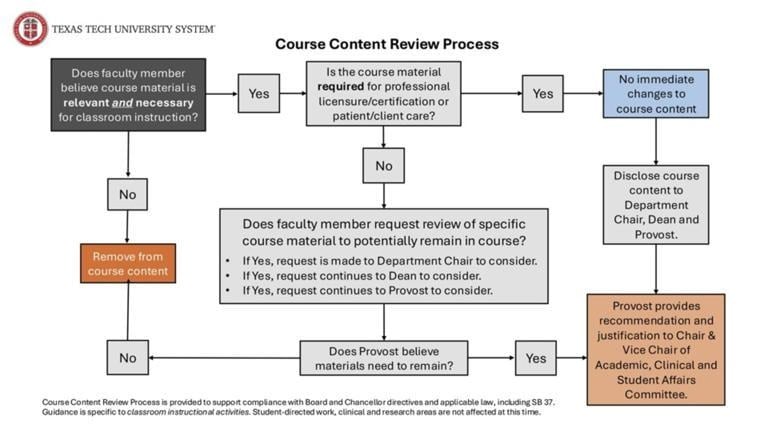
The TL;DR of that chart: Give up hope.
Law schools have been (thus far) relatively insulated, but I do not expect that to continue. Will courses disappear? Will there be risks to teaching employment discrimination? Are some areas of Con Law dangerous to teach now, such as Bostock or Skrmetti?
And does one think it will just involve gender? History shows us that powerful people often come after professors. Remember the attempt to fire Oklahoma professors who studied earthquakes related to fracking? And recent events in Louisiana related to environment and “Cancer Alley” demonstrate the tremendous pressures professors may face.
Law School Accreditation
I would be remiss if I didn’t mention that in this attack on higher education is another potential trap for law schools: The elimination of the ABA as an accrediting body. After four decades, the Texas Supreme Court issued an order that essentially eliminates the ABA as an accrediting body for Texas law schools. The ABA, as an aside, has been under attack by some, including the FTC chair, for having “a long history of leftist advocacy” (really? — even the Antitrust Section?) as well as attacks on the Trump-Vance administration (namely, wanting a rule of law).
I refuse to be put in an awkward position of defending a monopoly — one that, contrary to the FTC chair’s opinion, does not have a long history of leftist anything (look up National Lawyers Guild). But I am concerned that as states get on this bandwagon there will be 50 monopolies that create labor market barriers greater than those that already exist in the legal profession. Law schools seeking to comply with 50 state requirements would likely be unable to do so.
Why This Matters Beyond Texas
Texas is home to flagship institutions like the University of Texas at Austin, Texas A&M University, and the University of Houston. When a state as big as Texas recalibrates its relationship to academic governance, the effects ripple nationally. You see those effects in Ohio, Oklahoma, Florida, and elsewhere. And not just in “red” states.
It affects students. Faculty recruitment becomes harder. Out-of-state scholars hesitate to come here, even for conferences. Scholars already here seek to leave. You might say “good!” Until you realize that the very people who are destroying the system will be the first to send their kids outside the system they are destroying.
If the goal is to make Texas universities more politically compliant, these reforms are perfectly designed to create sycophantic, anti-intellectual institutions. But they replace institutions that were once great halls of learning, research, and academic advancement of society. Texas has taken a flamethrower and destroyed that, and regents and university administrators seem all too happy to help burn the place down.
There are First Amendment issues lurking here, particularly if enforcement drifts into viewpoint discrimination or retaliation for protected speech. Public universities are state actors. They cannot punish faculty for constitutionally protected expression. But it seems like what Texas public universities are doing is finding ways to fire faculty by making them walk tightropes of pledges and curriculum review.
Conclusion: Goodbye, Good Universities
Once higher education becomes an arena for direct partisan restructuring, every change in political power invites another structural overhaul. Universities cease to be stabilizing institutions and become spoils systems.
That’s not reform. That’s disaster. And I foresee the next Texas legislative session adding more gasoline to the fire.
PS: I did not list the Texas legislators who are getting their kicks tearing down higher education. Some have been hired by Texas universities! I don’t help people aura farm at the expense of the public good.
LawProfBlawg is an anonymous law professor. Follow him on X/Twitter/whatever (@lawprofblawg). He’s also on BlueSky, Mastodon, and Threads depending on his mood. Email him at lawprofblawg@gmail.com. The views of this blog post do not represent the views of his employer, his employer’s government, his Dean, his colleagues, his family, or himself.
The post Texas Takes A Flamethrower To Higher Ed (And Calls It ‘Reform’) appeared first on Above the Law.